
You know how to take care of
everyone and everything.
Taking care of yourself
has become harder.
You may already know a lot about wellness. You may know what you should be doing—and perhaps you’ve done it successfully before. But life changes. Responsibilities grow. And sometimes the approaches that once worked simply don’t fit the life you’re living now.
Mountain Awakening offers a different place to begin: not another set of rules or another promise to start over, but with a different understanding of where you are, what matters to you, and what sustainable change could look like in your life.
Knowing what to do and making it work in your life are two different things.
You’ve read the advice. You’ve made plans. You may have changed how you eat, started exercising, prioritized sleep, worked on stress, or promised yourself you would be more consistent this time.
And some of it may have worked — for a while.
Then life happened. A demanding season. A change in responsibilities, A move. A loss. A new role. An old routine that stopped fitting. Or perhaps nothing dramatic happened at all. What once felt manageable simply became harder to sustain.
It’s easy to interpret that as a lack of discipline or another failed attempt. But sustainable change asks for more than knowing the right things to do. It asks us to understand the patterns, circumstances, priorities, and behaviors that shape what is actually possible in our everyday lives.
That’s where a different kind of approach can begin.

CHANGE DOESN'T BEGIN WITH BECOMING SOMEONE DIFFERENT.
IT BEGINS WITH UNDERSTANDING
WHERE YOU ARE.
Mountain Awakening is a relationship-centered approach to wellness and behavior change built around a simple belief: sustainable change has to work in the context of real life.
That means we don’t begin with a prescribed plan or a list of everything you should change. We begin with you — what matters to you, what your life looks like now, what has and hasn’t worked before, and what you may be ready to explore.
Wellness is interconnected. Movement, nutrition, mindset, rest and recovery can all matter, but they don’t exist in isolation from your responsibilities, relationships, environment, experiences, and priorities. The goal isn’t to pursue perfection across every area. It’s to understand what matters now and identify changes that are meaningful enough — and realistic enough — to become part of how you live.
Because lasting change isn’t simply about doing more.
Sometimes it’s about learning to live differently.
CHANGE RARELY FOLLOWS A STRAIGHT PATH.
NEITHER DOES A MOUNTAIN.
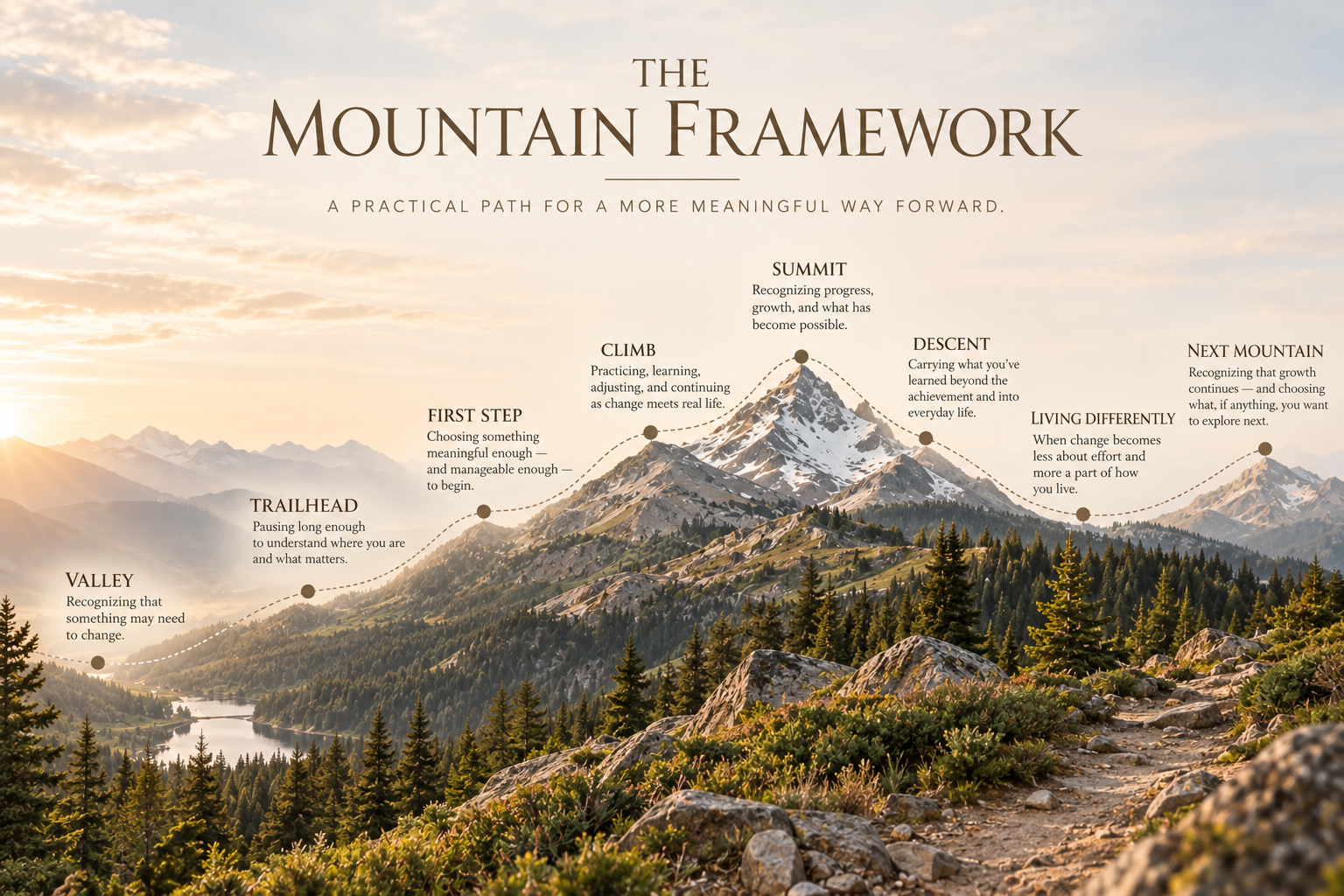
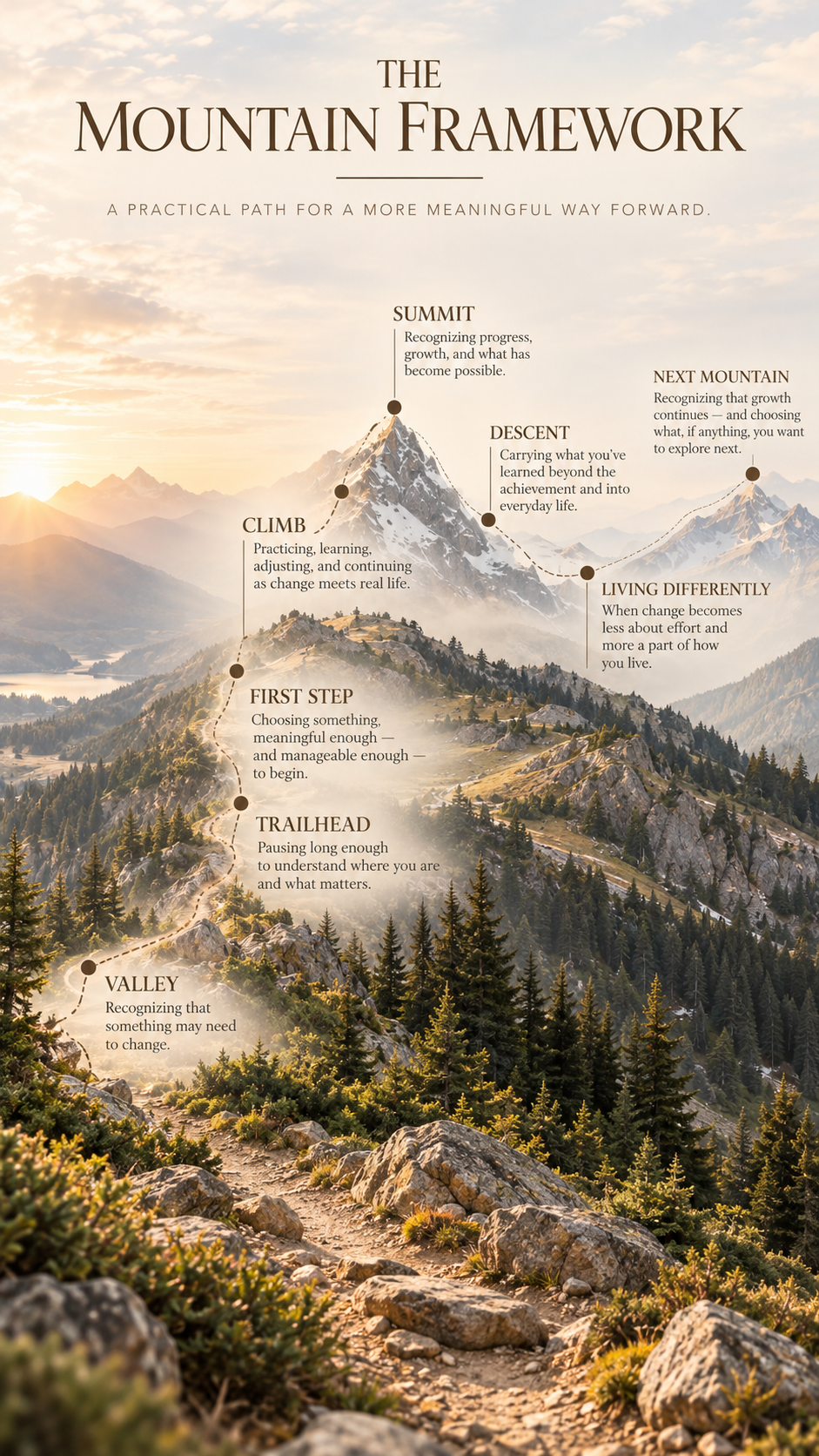
There are seasons when we feel stuck in the Valley and moments when we’re ready to find the Trailhead. There are First Steps that seem almost too small to matter, long stretches of Climb when change asks for patience and practice, and Summits that allow us to recognize just how far we’ve come.
But reaching a Summit isn’t the end.
There is a Descent—the often-overlooked work of carrying what we’ve learned back into everyday life. There is Living Differently, when change becomes less about what we’re trying to do and more about how we now live. And eventually, there may be a Next Mountain: another part of life asking for our attention, curiosity, or courage.
The Mountain Framework gives us a way to understand the landscape of change without prescribing the route through it.
Your path may move forward, circle back, pause, or reveal something you didn’t expect. You may recognize yourself in more than one place at the same time. The purpose isn’t to reach each stage correctly.
It’s to better understand where you are—and what might matter next.
COACHING
You don’t need another plan designed for someone else’s life.

Mountain Awakening Coaching is an individualized 12-week partnership for adults who want to make meaningful changes in their wellness—and want those changes to have a reasonable chance of surviving contact with real life.
We begin by understanding what matters to you. Together, we explore where you are now, what you want to be different, what may be getting in the way, and what kind of change. feels both meaningful and possible. Rather than handing you a prescribed wellness plan, coaching helps you develop your own path forward, with support, reflection, practical behavior-change strategies, and room to learn and adjust along the way.
Your wellness may involve movement, nutrition, mindset, rest and recovery—or some combination of them. But the work isn’t about improving every area at once. It’s about identifying what matters now and building changes that fit your priorities, circumstances, and capacity.
The 12-week coaching partnership includes eight private sessions, with more frequent support early in the process and additional space between sessions as you begin practicing and applying what you’re learning in everyday life.
And because sustainable change isn’t measured only by what happens while you’re being coached, the work also considers what comes afterward: how you carry what you’ve learned forward, recognize your own progress, and continue without needing someone else to constantly tell you what to do next

MEET MICHELLE
A different kind of wellness conversation starts with listening.

I’m Michelle Farkas, founder of Mountain Awakening and a Wellness & Behavior Change Strategist.
I came to this work with decades of experience leading, supporting, and working alongside people in demanding environments—and with my own experience of discovering that knowing what to do doesn’t always make change easy to sustain when life itself changes.
My approach to coaching is grounded in curiosity, not judgment. I don’t believe my role is to tell you how you should live, hand you a perfect plan, or measure your success against someone else’s definition of wellness. My role is to listen, ask thoughtful questions, help you recognize patterns and possibilities, and support you as you determine what meaningful change looks like for you.
My professional training through the National Academy of Sports Medicine includes credentials in wellness coaching, nutrition coaching, behavior change, weight loss, and stretching and flexibility. That education informs my work, but it doesn’t replace the person sitting across from me.
Because coaching begins with something more fundamental than credentials:
Understanding who I’m working with.